
The Story Behind Shagrir’s Film on Ethiopian Jews in Israel
Micha Shagrir’s film about the Ethiopian Jewish community in Israel belongs to a period when migration, identity and national memory were being argued through television and documentary cinema. Its significance lies in the way it brings a major historical movement down to the level of faces, homes, conversations and unsettled lives. Ethiopian Jews were not simply represented as newcomers rescued by the state; their arrival exposed difficult questions about belonging, religion, race and citizenship. Learn more about Micha Shagrir S Early Experiments With Color Photography In The 1960s 94bbc3.
The Shagrir Collection provides a valuable way to look behind the finished film. Photographs, negatives, production records, recordings and related journalism help place the documentary within the wider culture of Israeli media. For viewers in Australia, where migration stories are often encountered through SBS, community broadcasting and multicultural film festivals, this material offers a useful comparison: it shows how a filmmaker can record a national event while still allowing individuals to speak with their own complexity.
A Community Arriving In A Divided Society
The film’s background begins with the long history of Ethiopian Jews, many of whom maintained Jewish religious traditions and a distinct communal identity while living in Ethiopia. Their movement to Israel accelerated during the 1980s, especially through Operation Moses, and continued on a much larger scale during Operation Solomon in 1991. These dramatic airlifts were celebrated as moments of rescue and return, yet the experience after arrival was far less simple.
New immigrants often spent months in absorption centres, temporary housing and transit camps while learning Hebrew and navigating unfamiliar institutions. Families faced economic insecurity, cultural dislocation and the loss of authority that can accompany dependence on officials, interpreters and welfare agencies. Questions about Jewish status also created humiliation and frustration, particularly when religious authorities demanded symbolic or ritual steps from people who understood themselves as Jewish already.
Shagrir’s approach is important because it can hold those conflicting realities together. The community appears within the story of Israeli state-building, but it is not reduced to a national success story. The camera’s attention to ordinary speech, domestic space and public encounters makes immigration visible as a lived process rather than a single spectacular event.
From News Event To Human Documentary
Shagrir had worked across journalism, photography, television and documentary production, and that professional range shaped his way of seeing. He understood the speed of news, but he also recognised that footage gathered for immediate reporting could become a historical record. His earlier engagement with current affairs is explored in the collection’s account of his magazine-to-television influence, which helps explain the balance between urgent public questions and close observation.
The Ethiopian Jewish story required that balance. Images of aircraft, crowds and official ceremonies carried enormous symbolic power, yet such scenes could flatten the people being filmed into a heroic national tableau. A more attentive documentary asks what happens after the cameras move away from the runway: how parents manage a new school system, how young people translate between languages, and how family memories survive in a new landscape.
This is where the film’s human scale matters. It encourages viewers to see migration as a series of negotiations. A conversation with a government worker, a child’s experience at school or a family’s account of religious practice can reveal more than a formal statement about integration. Shagrir’s background as a journalist gave the film a concern for public responsibility, while his photographic eye made room for silence, gesture and visual detail.
The Archive Behind The Screen
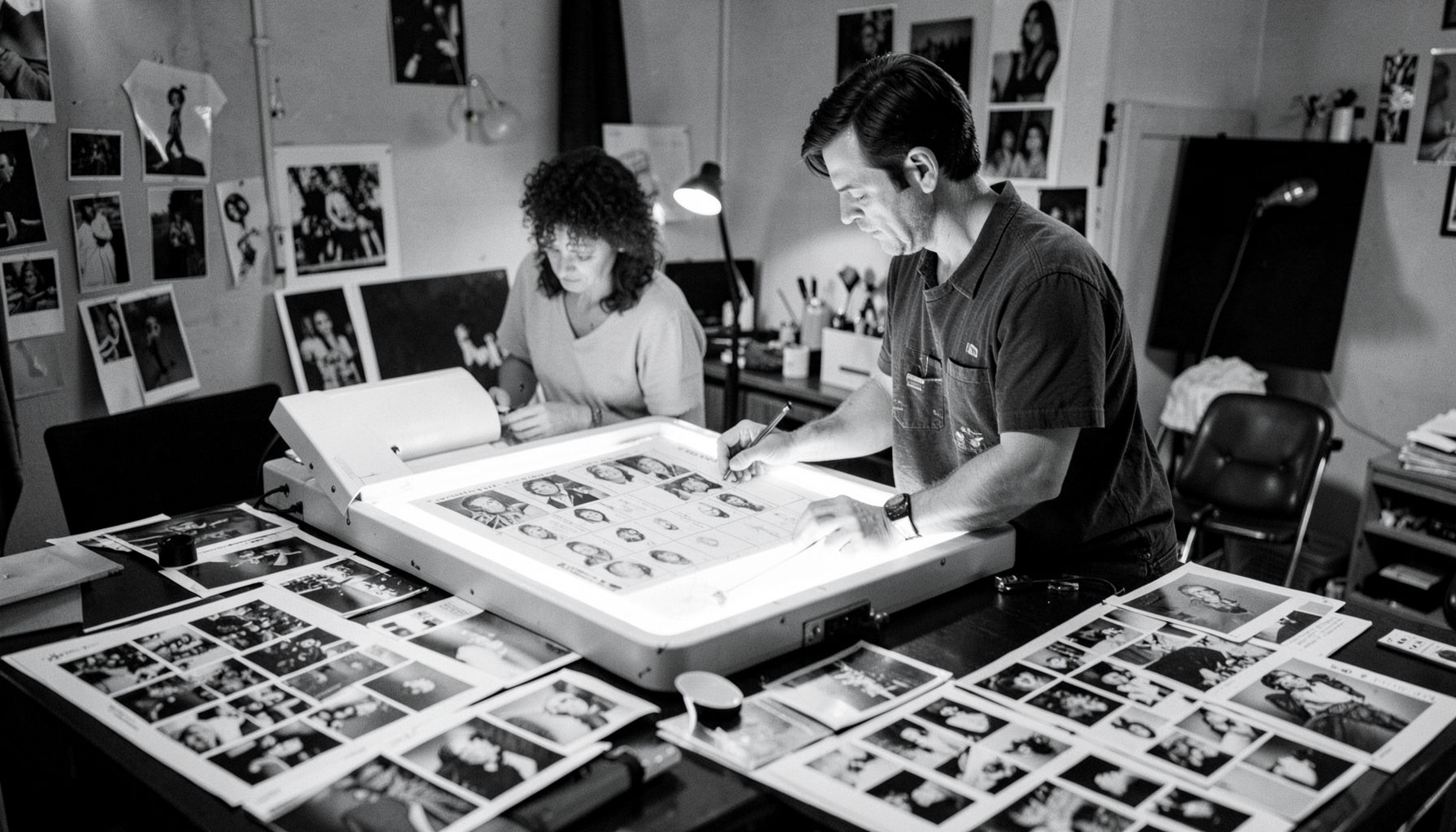
The surviving material connected with Shagrir’s work can deepen what is visible in the documentary itself. Contact sheets, still photographs, production notes and unused footage may show how scenes were selected, framed and sequenced. Even when a particular item does not appear in the final edit, it can reveal the ethical and practical decisions involved in filming people whose lives were already being interpreted by institutions.
His interest in visual experiment also forms part of that context. The collection’s discussion of early colour photography demonstrates that his documentary language developed through photography as much as through television. Colour, contrast, texture and the arrangement of bodies within a frame can influence whether a community appears distant, exoticised, familiar or fully present.
For researchers, this distinction between the released film and the wider archive is crucial. A completed documentary is an argument shaped by time limits, broadcasters and editorial choices. Archival material gives future audiences the chance to test that argument, identify omissions and understand the working relationship between filmmaker and subject. It also preserves evidence of the production process, which is often lost when television work is treated as disposable news.
Representation, Protest And Public Memory
The arrival of Ethiopian Jews did not end with absorption. Over the following decades, Ethiopian Israelis challenged discrimination in employment, housing, education, policing and religious life. Public protests, including major demonstrations in the 1990s and later nationwide rallies, showed that the community was actively shaping Israeli politics rather than waiting to be included in someone else’s national narrative.
Shagrir’s broader coverage of social conflict provides a useful comparison. His reporting on Israeli labour strikes reflects an interest in the relationship between personal hardship and organised public action. That perspective helps situate the Ethiopian Jewish film within a larger body of work concerned with workers, marginalised groups and the institutions that claim to speak for them.
For Australian viewers, the parallel is recognisable without being identical. Debates about settlement services, racial discrimination and the representation of migrant communities have appeared in Sydney and Melbourne media for decades. SBS has often provided space for multilingual and multicultural perspectives, while community festivals and local radio allow groups to tell stories outside the main commercial news cycle. Shagrir’s film raises the same broad question relevant to Australia: who controls the image of a community during a period of public controversy?
Why The Film Still Matters In Australia
The documentary has continuing value because it connects migration history with the everyday work of citizenship. It can be viewed alongside Australian discussions about refugee settlement, family reunion and cultural identity, including the experiences of Ethiopian and other African communities in Melbourne, Sydney, Brisbane and Perth. These comparisons need care, since Israel’s religious and political history differs greatly from Australia’s, but they can help audiences recognise recurring pressures around language, schooling and public representation.
There is also a practical archival lesson for Australia. The National Film and Sound Archive in Canberra, state libraries and university collections preserve moving-image records that might otherwise disappear from public memory. When a documentary is digitised and described properly, it becomes useful to teachers, historians and community researchers rather than remaining available only to specialists. A film screening at an Australian Jewish museum, a university program or a multicultural festival can therefore become a starting point for discussion rather than a nostalgic presentation of the past.
The Shagrir Collection extends that work by bringing related evidence together online. Its materials invite viewers to consider how a film was made, whose voice was heard and what later histories add to the original account. Researchers such as Deepali Gupta demonstrate the value of crossing disciplines when studying visual culture, archives and public memory.
The story behind Shagrir’s film is ultimately the story of a meeting between national drama and individual experience. Ethiopian Jews arrived in Israel carrying a history that was older than the state receiving them, while the filmmaker recorded the uncertainty of their first encounters with a new society. Preserved photographs, documents and moving images ensure that this history remains open to scrutiny, allowing each generation to look beyond the headline of rescue and see the long, unfinished work of belonging.