
Cross-continental correspondence: Micha Shagrir's filmmaker letters
The Shagrir Collection holds thousands of documents that trace the working relationships Micha Shagrir built across decades of journalistic and filmmaking activity. Among the most compelling materials catalogued in the about section of the archive are his personal letters, postcards, and telegrams exchanged with documentary producers and independent filmmakers working in Europe, North America, and the Asia-Pacific region. These written exchanges illuminate both the practical logistics of co-productions and news gathering alongside the personal friendships that sustained Shagrir through some of the most turbulent decades of the twentieth century.
The correspondence offers researchers a rare window into how information, footage, and political analysis moved between continents before the era of digital communication. Each letter functions simultaneously as a historical record, a creative document, and a personal artifact. For Australian scholars in particular, the collection provides a unique bridge between Israeli documentary traditions and the broader network of filmmakers that shaped the global South Pacific media landscape during the post-war era.
The origins of a transnational dialogue
Shagrir's first sustained international correspondences emerged in the late 1950s, when Israeli documentary output was rapidly professionalising and seeking distribution partners abroad. Letters held in the archive show early exchanges with French and British filmmakers interested in the young state's pioneering spirit. Typewritten on plain paper, signed in Shagrir's characteristic hand, these early communications often requested footage, discussed equipment shipments, and arranged screening dates for short documentaries produced by Israeli production houses.
The correspondence also documents Shagrir's role as an unofficial ambassador for Israeli cinema. He wrote extensive accounts of local production conditions, festival politics, and the small but determined community of filmmakers working in Tel Aviv and Jerusalem during the period. Many letters from this era reference names and projects that would later become central to Israeli documentary history, providing historians with an unusually granular record of professional networks that shaped the field.
Letters from the documentary front
A significant portion of the archive relates to Shagrir's documentary projects covering regional and global crises. Letters from the early 1970s discuss the challenges of filming under wartime conditions, the logistics of news reels, and the ethics of documentary coverage. A dedicated blog entry on oil crisis documentation examines one specific campaign of correspondence related to his coverage of the 1973 energy shock.
Among the most studied threads are those exchanged with Greek, Italian, and British documentarians covering the eastern Mediterranean. These letters frequently debated the visual language of conflict reporting and the political responsibilities of the camera. A summary of selected correspondents and their primary interests appears below.
| Correspondent | Country | Primary subject matter | Approximate period |
|---|---|---|---|
| Yannis Markopoulos | Greece | Mediterranean politics | 1962–1978 |
| Lino Miccichè | Italy | Italian neorealism and Israeli parallels | 1965–1974 |
| Peter Watkins | United Kingdom | Documentary ethics | 1969–1981 |
| Patricio Guzmán | Chile | Exile filmmaking | 1975–1989 |
| Merata Mita | New Zealand | Indigenous documentary methods | 2009–2014 |
| Avi Mograbi | Israel | Personal essay film exchange | 1985–2003 |
This summary reflects only a small selection of the correspondents whose work is documented within the collection. Many letters remain uncatalogued, and the archive continues to receive additional materials through ongoing donations from filmmakers and their estates.
Echoes from European cinemas
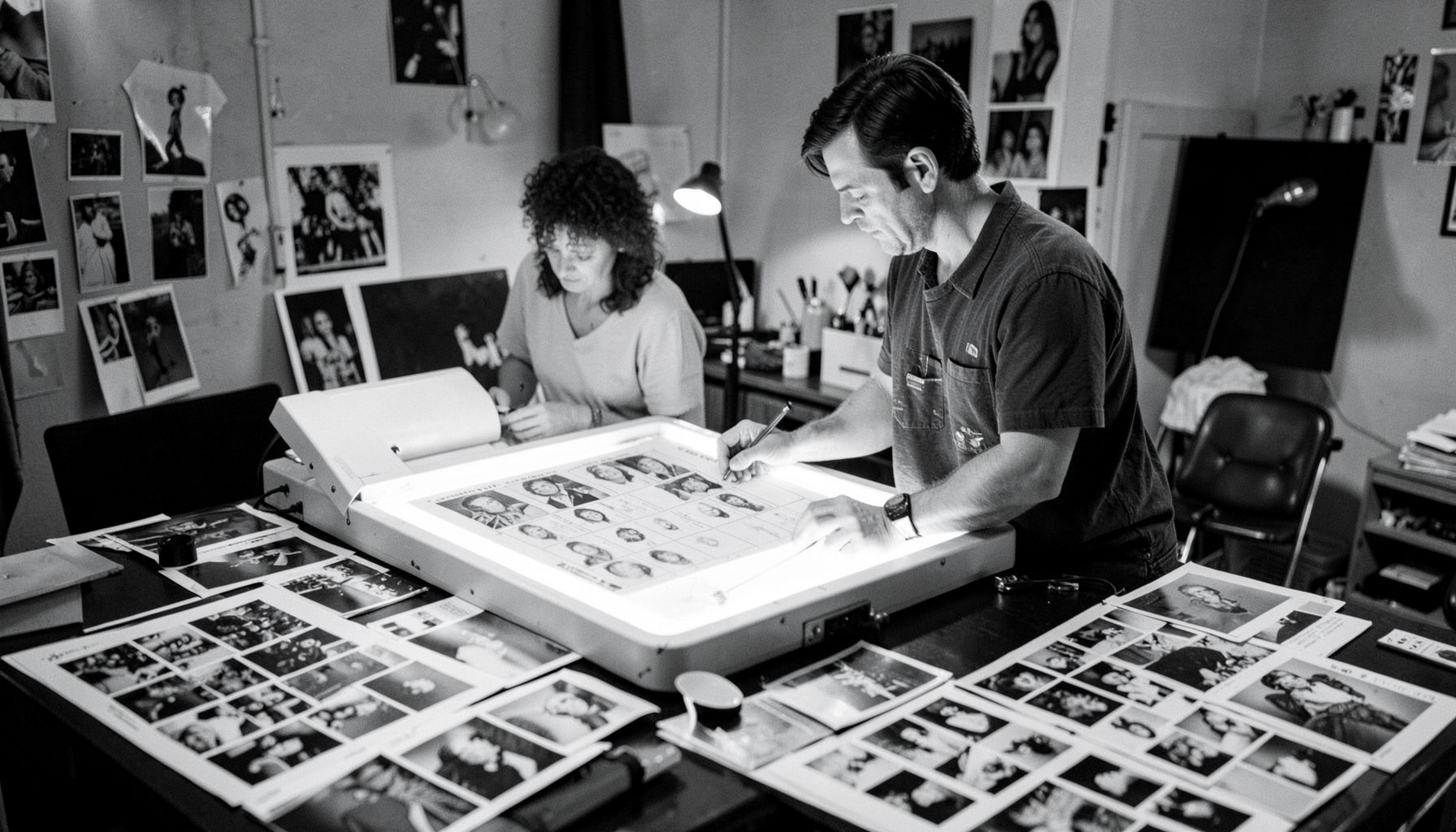
The European correspondence files are among the most extensive in the archive. Letters exchanged with Czechoslovak, French, and West German filmmakers during the 1960s and 1970s reveal the deep curiosity of European documentarians toward Israeli production models. Shagrir often enclosed photographic prints and contact sheets with his replies, and several folders contain annotated negatives and landscape photography exchanged between filmmaker-photographers who worked across continents.
His involvement with the French newsreel tradition held significant influence over the visual grammar of Israeli journalism during the period. Letters from French correspondents in Paris discuss cinematic conventions, archival footage licensing, and the potential for joint Franco-Israeli news production. The tone shifts between formal business correspondence and warm personal exchanges, depending on the length and depth of the relationship. Several reply letters written from the south of France during festival breaks provide insights into how informal networks sustained longer collaborative projects.
Connections across the Pacific
Australian filmmakers and editors feature prominently in the later decades of the archive, particularly from the 1980s onward. Letters held in the collection document exchanges with producers from the Australian Broadcasting Corporation and the Special Broadcasting Service, as well as with independent filmmakers in Sydney and Melbourne who were working on Middle East-focused documentaries. These correspondences illuminate how Australian content regulations shaped the kinds of Middle Eastern stories that could reach Australian screens.
The Australian connection extended to Melbourne's internationally recognised film festival circuit and to documentary producers supported through the funding frameworks administered by Screen Australia and its predecessor bodies. Several Melbourne-based filmmakers wrote to Shagrir seeking archival footage for projects on Australian involvement in United Nations peacekeeping operations in the Sinai Peninsula. These exchanges helped shape later Australian documentaries that reached the Sydney Film Festival and the Brisbane International Film Festival, often accompanied by Israeli co-production credits that traced back to those early letters.
A separate cluster of letters relates to Shagrir's interest in Indigenous Australian documentary practice, which he encountered at screenings in Adelaide and through visiting filmmakers who stopped in Israel on their way to regional festivals. The archive preserves Shagrir's handwritten responses to several of these films, offering a personal critical record that complements more formal Australian film criticism from the period.
Preserving the written word
The fragile nature of the materials presents constant challenges for archivists. Paper stored in tropical climates or in unheated rooms tends to yellow, and many of Shagrir's letters bear the marks of being folded multiple times, posted in international airmail envelopes, and carried through humid Middle Eastern summers. Conservators working with the military ceremonies collection have documented similar conservation challenges for related materials held elsewhere in the archive.
Digitisation projects have made a substantial portion of the letters available to remote researchers. Because international correspondence was often lost, discarded, or damaged before being formally archived, the odds of preservation for any one letter were slim. Each preserved letter represents an unusual run of good fortune for researchers who study them today. The Shagrir Collection has invested in cold-chain storage, professional re-housing of fragile items, and the creation of high-resolution digital surrogates that can be shared with international researchers without handling the originals.
Working with the archive: recommendations for researchers
Researchers interested in engaging with Shagrir's correspondence files should consider the following practical steps.
- Begin with the archive's online finding aids to identify which correspondence series relate to your period of interest, since letters are arranged chronologically and by correspondent.
- Request access to digital surrogates before visiting in person, as fragile originals can only be consulted under supervision and with appropriate handling protocols.
- Plan a multi-day visit if you intend to work across multiple series, because transit time between storage locations can extend a single appointment.
- Connect with relevant Australian institutions such as the National Film and Sound Archive in Canberra, since cross-referencing holdings there can identify Australian counterparts mentioned in Shagrir's letters.
- Photograph or scan any items you consult in published work, and provide the archive with courtesy copies of resulting publications to support ongoing conservation efforts.
- Consult the archive's educational programs to learn about handling techniques and conservation standards, particularly when working with items that show signs of deterioration.
This guidance will help ensure both thorough research outcomes and the continued preservation of these irreplaceable materials for future generations of scholars and filmmakers.