
Shagrir’s 1983 Series and the Many Faces of Israel
A deep dive into Shagrir’s 1983 series on Israeli minorities reveals a body of work shaped by observation, movement and historical urgency. The photographs and related records belong to a period when Israeli society was being debated through questions of migration, citizenship, religion, military service and cultural belonging.
Micha Shagrir worked across documentary film, photography, journalism and production. That varied practice matters here because the series should not be approached as a set of isolated portraits. It forms part of a larger media archive in which still images, moving pictures, interviews, notes and personal papers can be read together.
The collection also offers a way to examine how minority communities appeared within Israeli public life during the early 1980s. The images can show everyday routines, but they may also reveal who is being watched, who is given space to speak and which details a filmmaker considered historically important.
For Australian readers, the series has a particular resonance. Questions about migration, minority representation and national identity are familiar in Melbourne, Sydney, Canberra and regional communities, while local institutions such as the National Film and Sound Archive and Trove have made archival research part of public cultural life.
Israel in 1983 and the archive’s historical frame
The year 1983 sits within a turbulent chapter of Israeli history. The country was living through the aftermath of the 1982 Lebanon War, intense political disagreement and continuing social tensions connected to immigration, ethnicity and the relationship between Jewish and Arab citizens. A photographic series made in this climate inevitably carries more than visual information: it records the atmosphere surrounding people and places.
Shagrir’s work is valuable because it can be approached at several scales. A street scene may point to national policy, while a family interior can preserve details absent from official accounts. Clothing, architecture, signage, gestures and forms of work help locate communities within the political geography of Israel without reducing them to headline events.
The Shagrir Collection archive brings these materials together in a setting that encourages comparison. Rather than treating a single photograph as definitive evidence, researchers can consider how it relates to other documents from the same period and to Shagrir’s wider career.
A documentary style built from proximity
The series appears most productive when read as a study in proximity. Shagrir’s camera often places the viewer near ordinary social situations instead of presenting minority communities as distant subjects. Faces, domestic spaces and working environments can create an impression of access, yet that access always depends on the photographer’s position and choices.
This is where his experience as a filmmaker becomes significant. Film encourages attention to sequence, duration and the relationship between a person’s spoken account and their visible surroundings. Even when viewing a still photograph, audiences can imagine the larger encounter: what happened before the shutter opened, what continued afterwards and what may have been excluded.
A useful comparison can be made with Shagrir’s kibbutz photo series. That earlier or parallel interest in collective life helps clarify how he observed labour, shared space and group identity. The 1983 minority series shifts the social setting, yet retains an interest in how communities organise daily experience.
Beyond the label of minority
The word “minority” can be historically useful while remaining incomplete. It may describe a community’s position in relation to state power, population size or public visibility, but it does not capture internal differences. Religious practice, language, class, gender, generation and urban or rural location can shape people’s lives in very different ways.
A close reading should therefore resist turning the series into a catalogue of types. A portrait should not stand in for an entire community, and a distinctive garment should not be treated as proof of a fixed tradition. Instead, the image can be examined for relationships: who is present, how people interact, what surrounds them and how confidently they meet the camera.
Shagrir’s archive is especially useful for this work because photographs can be placed beside documentary footage and written records. A person who seems silent in a still image may have a substantial voice elsewhere in the collection. This is also why the archive’s material on Israeli fashion history matters: dress can be read as personal expression, social memory and evidence of changing public identities.
What the photographs preserve
The strongest historical evidence may sit in details that were not the official subject. Shopfronts, road signs, household objects, hairstyles, children’s activities and patterns of work can help researchers reconstruct a social world. These fragments are particularly important when official records describe institutions more readily than people’s everyday lives.
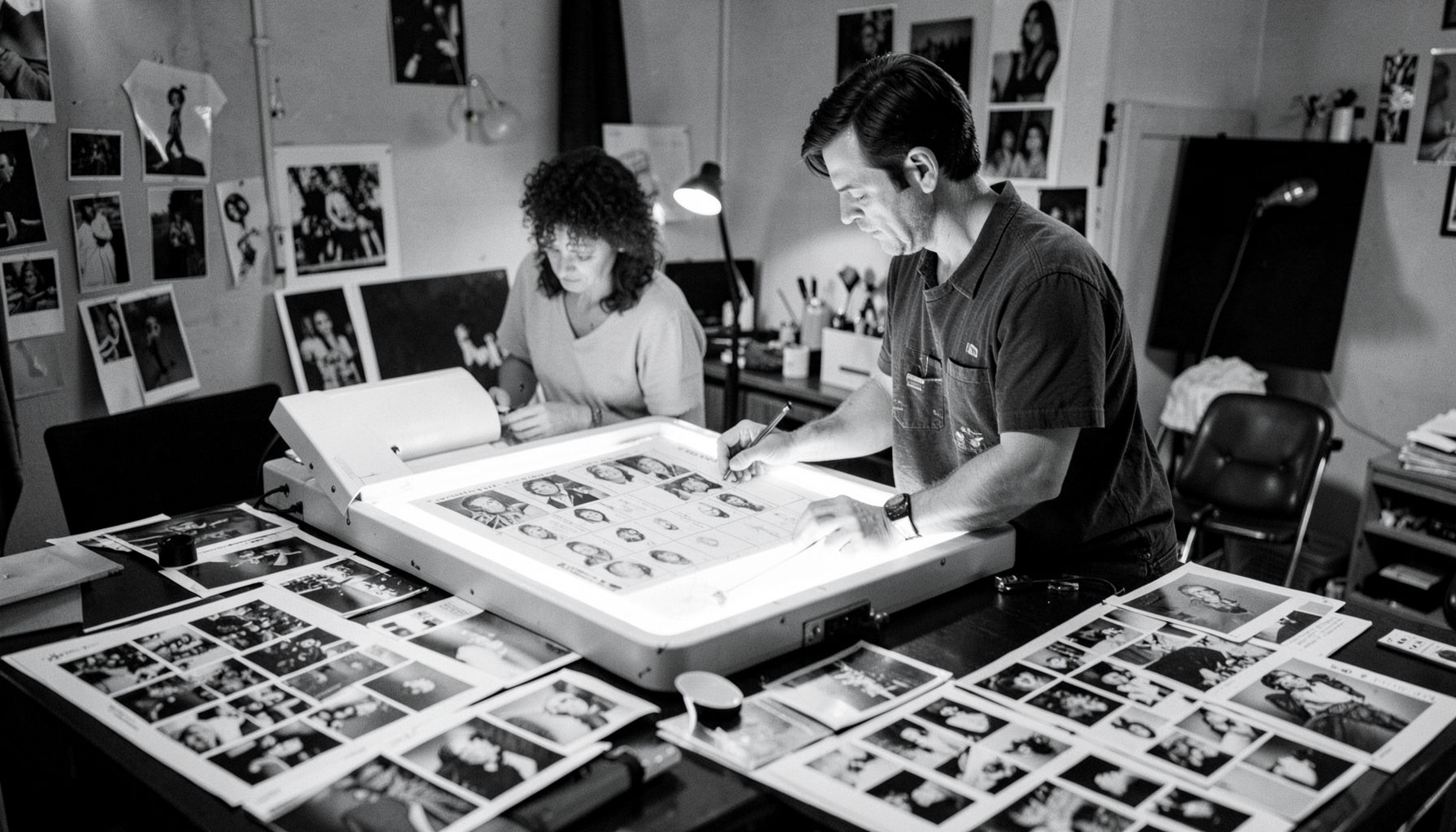
Photographic negatives and prints also preserve technical information. Framing, exposure, sequence and repetition may indicate whether Shagrir was seeking a formal portrait, recording an event or building a visual narrative over time. Comparing contact sheets with selected prints can show how an image was edited before it reached an audience.
Evidence worth following across the series
- Repeated locations, buildings or street signs
- Differences between posed portraits and candid scenes
- Clothing, domestic objects and forms of religious practice
- The presence or absence of women, children and older residents
- Captions, dates and notes attached to the original material
These clues should be treated as connected evidence rather than isolated curiosities. A caption may correct an assumption created by the image, while a second photograph can reveal that a seemingly private setting was part of a public gathering.
Representation, consent and historical distance
The series also raises ethical questions about documentary authority. A photographer may intend to create visibility, yet the resulting image can later be used by audiences who know little about the person pictured. Historical research must account for that gap between the original encounter and present-day interpretation.
Consent is part of this discussion, especially when images show children, family homes or politically sensitive communities. The archive’s role is not simply to make everything visible without context. Accurate identification, careful description and respect for community knowledge can help prevent archival access from becoming another form of extraction.
Digital audiences often encounter archival photographs through search results or social media fragments. A thoughtful presentation needs provenance, dates and explanatory text. Resources such as Kifli Mally can sit within a wider digital culture of accessible online material, but specialist archival records still require careful editorial framing and source criticism.
Why the series matters in Australia
Australian viewers can recognise several of the series’ underlying concerns without equating Israeli history with Australian experience. In Melbourne and Sydney, migrant neighbourhoods are often represented through food, language and festivals, while the deeper stories of work, displacement and political participation receive less attention. Shagrir’s photographs encourage a more patient form of looking.
There are useful institutional parallels in Canberra, where the National Film and Sound Archive preserves audiovisual history, and through Trove, which allows researchers to connect photographs with newspapers and public records. For a student or curator working in Brisbane, Adelaide or Perth, these models demonstrate how a local archive can become a bridge between personal memory and national history.
The Australian cultural market also shapes how such material is encountered. SBS audiences are accustomed to multilingual documentary storytelling, while museum visitors may expect exhibitions to explain cultural context rather than present images as visual spectacle. Jewish communities in Melbourne and Sydney, as well as Arabic-speaking and other migrant communities across Australia, may bring their own memories and comparisons to the series.
Australian points of connection
- Canberra’s archival institutions and public research programs
- Melbourne’s and Sydney’s multicultural neighbourhood histories
- SBS traditions of multilingual documentary programming
- Trove searches linking photographs with newspapers and advertisements
- Museum and gallery audiences seeking community-led interpretation
These connections make the series relevant without flattening its setting into an Australian analogy. The value lies in comparing methods: how photographs are captioned, how communities participate in interpretation and how public institutions decide which histories deserve preservation.
From private collection to public research
A deep reading of the 1983 material depends on the archive’s physical and intellectual organisation. Negatives, prints, films, recordings and papers each carry different kinds of evidence. Their relationship can reveal how a project developed, how it was edited and how Shagrir’s understanding of a community changed across repeated visits.
Researchers should also pay attention to gaps. Missing dates, unidentified people or incomplete sequences are not minor inconveniences; they show where further oral history, community research or technical conservation may be needed. A photograph becomes more useful when uncertainty is recorded honestly rather than hidden behind a confident caption.
The archive’s preservation work gives the series a future beyond its original publication. Exhibition design, educational programs and responsible digitisation can bring the material to new audiences while retaining its historical complexity. Public support for the collection helps ensure that Israeli social history remains available for researchers, teachers, filmmakers and communities.
Some readers may approach the archive through visual culture, others through migration history or documentary ethics. Even financial and institutional questions matter, since conservation, digitisation and access require long-term resources; a broader discussion of investment and preservation can help frame why cultural collections need sustainable support without reducing their value to profit.
Shagrir’s 1983 series ultimately invites a layered encounter with Israeli life. Its importance rests in the tension between the individual image and the larger historical record: a face and a policy, a household and a national debate, an everyday gesture and the lasting question of who gets represented.