Shagrir’s Portraits and the Making of Israeli Literary Culture
Israeli filmmaker, producer, photographer and journalist Micha Shagrir’s portraits of Israeli writers and poets form more than a gallery of familiar faces. Across his decades-long career, Shagrir placed authorship inside the visible machinery of a nation: newspaper desks, editorial offices, literary evenings, borders, war and public ceremony. The Shagrir Collection preserves negatives, prints, films, recordings and personal papers, allowing each portrait to be read beside the events and documents that shaped its making. The result is a chronicle of Hebrew literary culture and the changing social authority of writers in Israel.
For Australian readers, the collection is both foreign and recognisable. A poet interviewed by a newspaper photographer recalls a world of typescripts, syndicated columns and crowded launches, while the archive’s handling of fragile originals offers a parallel with the collecting habits of Canberra’s National Library and state libraries such as State Library Victoria. The portraits can support teaching, publishing and exhibition, yet their distance also requires care: unfamiliar political history, Hebrew-language print culture and the ethics of depicting public figures should not be flattened into a simple gallery of celebrated authors.
Writers in the public frame
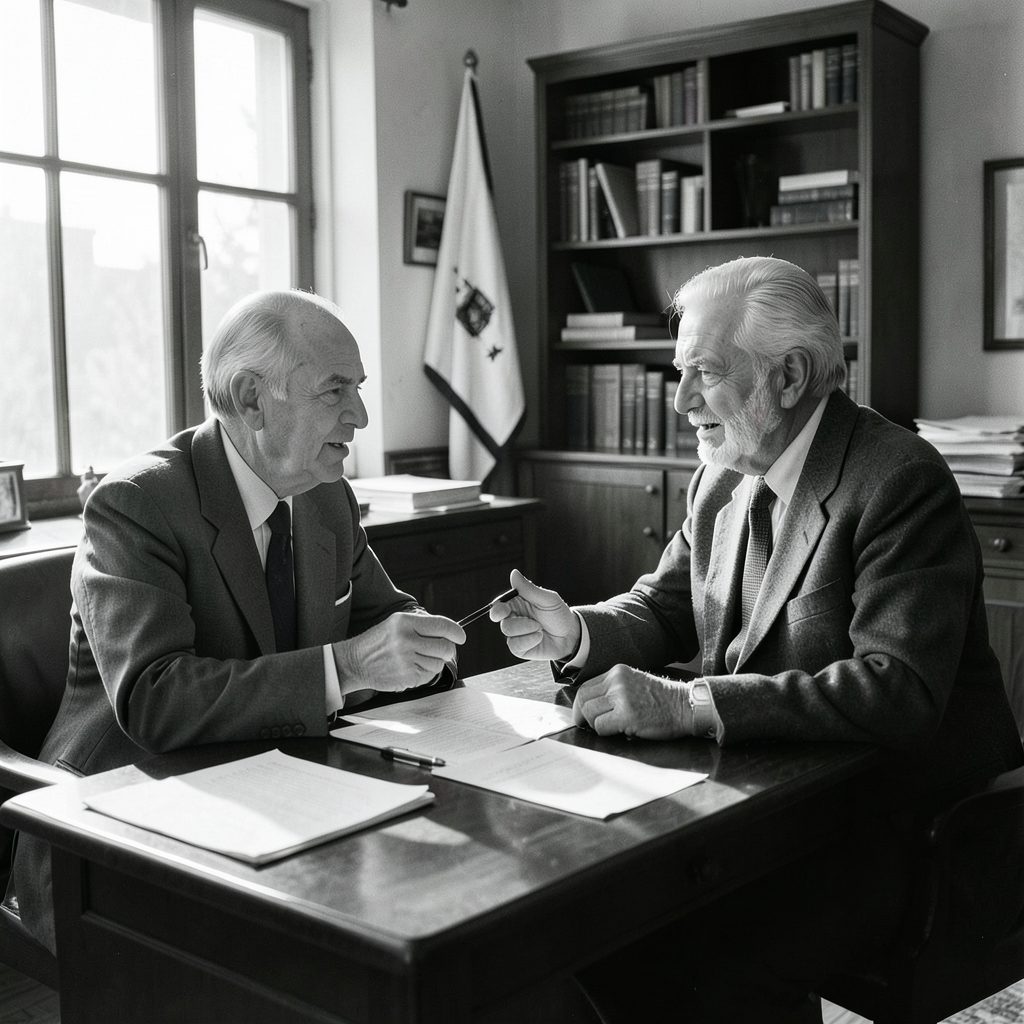
Shagrir’s work belongs to documentary practice. As photographer, filmmaker, producer and journalist, he encountered writers through assignments, cultural events and the daily news cycle rather than through a sealed studio identity. The same face might appear in a profile, beside a book review, or at a public occasion. Each photograph therefore records both a person and a role: the private individual is being made legible as an author, editor, translator or public intellectual.
The collection maps a literary world reshaped by Zionist migration, Mandate Palestine, the creation of Israel, successive wars and the expansion of mass media. Its subjects belong to different generations and forms of cultural work, from poetry and fiction to journalism, broadcasting and cultural diplomacy. Read chronologically, their portraits show how literary reputation moved between manuscript, newspaper, radio, television and public ritual. They also reveal the choices behind the canon, since the people selected for a camera were shaped by editors, institutions and a changing idea of who represented the nation. A catalogue can also be tested for exclusions built into that process, including the uneven visibility of women, translated authors and writers working outside Hebrew.
Portraits as historical evidence
A portrait is evidence, but not a transparent window. Clothing, posture, age, expression and the objects around a sitter can establish circumstance, yet a photographer also directs the scene. A manuscript on a desk may signify working identity, while a formal pose may satisfy an editor’s idea of seriousness. Researchers should describe what is visible before interpreting what it means, separating evidence of the encounter from the later history attached to the writer’s name.
Captions and publication history are equally important. A print reproduced in a magazine may have been cropped, retouched or paired with an editorial judgment that now differs from the portrait itself. Nearby frames, contact sheets and negatives can reveal alternative moments. The archive’s recordings and papers may also preserve a writer’s voice or working context. Together, image and text create a richer record, but they can still disagree, and that friction is valuable rather than a defect to smooth away.
Practical use also raises questions of ownership and consent. A writer’s photograph, a publisher’s text and an archive’s negative may involve different rights holders, while later educational or commercial uses can trigger separate permissions. Before reproducing material, consult the collection’s copyright and permissions guidance and distinguish the rights in the image from those in related documents. Clear credit lines should name the photographer, sitter, collection and source publication where known, not simply the institution holding the file.
A disciplined way to research the images
A strong research method is simple, transparent and repeatable. Catalogue records and physical markings should come first, followed by contextual checks in newspapers, books, broadcasts and associated papers. The following recommendations keep the portrait central without pretending that a visual impression can speak for an entire life.
- Establish the basic record. Confirm the sitter, photographer, date, place, medium and catalogue number before interpreting pose or expression.
- Compare every available version. Study prints and negatives together, including marginal notes, crop marks, captions and adjacent frames that may alter the apparent meaning.
- Trace publication history. Search Hebrew and transliterated names in periodicals, literary journals, radio archives and exhibition catalogues to locate the original caption and purpose.
- Build a context file. Pair portraits with recordings, manuscripts, letters and public statements, recording where the formats agree, conflict or leave a gap.
- Separate observation from inference. Use neutral visual descriptions, cite the source of each claim and note uncertainty instead of projecting a literary identity onto a face.
This layered approach can produce a micro-history of Israeli cultural life. A changed hairstyle may mark a period of military service; a new location may follow a change of publisher or political circumstance. Such clues become persuasive only when documentary evidence supports them, and the final account should say plainly where interpretation begins.
Preservation and the wider research web
Preservation is part of interpretation, not housekeeping after it. Negatives require stable temperature and controlled handling; prints can be damaged by light, acidity or careless mounting; magnetic recordings and digital files face their own technical obsolescence. The collection’s mixture of formats therefore needs active storage, regular digitisation, durable metadata and conservation records. An image without a date, a name or a provenance note may survive physically while losing its usefulness to history.
Digitisation should be paired with context, not treated as a substitute for it. High-resolution files can reveal a caption, signature or studio address, while exhibitions and educational programmes can explain how photographs entered newspapers, books and collective memory. Researchers often need to move between institutional holdings and independent publishing. An independent site such as Deepali Gupta can sit on that broader research trail, but its authorship, date and relevance should be verified before it is used alongside the Shagrir Collection’s primary sources.
Australian institutions and public memory
Australia offers several productive points of contact. Canberra’s National Library and National Archives model national collecting and public access; Melbourne combines State Library Victoria’s manuscript programmes with a dense network of literary events, cafés and galleries; Jewish Museum Sydney and community archives provide a closer bridge to Israeli and Jewish cultural history. These institutions know the value of preserving personal papers alongside official records. They also understand that a photograph can enter civic memory differently depending on whether it was made by a news service, commissioned by a publisher or kept by a family.
Australian cultural markets are distributed across public galleries, universities, independent bookshops, festivals and regional public-library networks rather than organised around a single publishing capital. In conversation, “have a crack” often signals a friendly attempt at a difficult problem, a useful spirit for teaching researchers to examine provenance and missing context. The ideal of a “fair go” also has a material meaning for archives: access should not depend only on proximity to a major institution or specialist knowledge. Digital delivery, translated finding aids and travelling or online exhibitions can make this material workable for schools, reading groups and regional researchers.
The wider web adds another layer. The Shagrir blog includes a page on FairGo casino coupons, which is not part of the archive’s scholarly interpretation but shows how specialist publishing can sit beside commercial material in Australian search results. Clear titles, internal links and descriptive metadata help readers distinguish cultural evidence from promotion. Used carefully, Shagrir’s writer portraits can support Australian discussions of migration, translation, censorship, public responsibility and the power of institutions to decide which faces become national symbols. Viewed in this way, the collection is less a sealed shrine than a working instrument for recovering how literature, identity and public history were made visible.