
Shagrir and Ethiopia’s famine in the 1980s
Micha Shagrir approached the major events of his era through documentary photography, filmmaking and journalism. His archive preserves negatives, prints, films, recordings, newspaper pages and personal papers created across a long career in Israeli media. These materials document political upheaval, military conflict and social change, while retaining the practical details of how news was reported and historical events were represented.
Shagrir’s coverage of the Ethiopian drought and Israel’s response belongs to this wider body of work. It connects a regional humanitarian catastrophe with debates about aid, migration and national responsibility. His images and reporting also reveal a tension at the heart of the story: Israel acted energetically to evacuate Ethiopian Jews while millions of other drought-affected Ethiopians remained dependent on a slower and less complete international relief effort.
Drought, displacement and a delayed response
Successive failures of rainfall in the Horn of Africa between 1980 and 1984 destroyed crops, depleted livestock and disrupted rural communities. The resulting famine was intensified by conflict, displacement, damaged infrastructure and limited government capacity. People moved towards towns and relief camps in areas including Tigray and Wollo, where dependence on food aid increased as local supplies collapsed.
The scale of human need was enormous, although estimates of famine deaths vary because access, registration and record-keeping were poor. International agencies and foreign governments faced substantial barriers when attempting to reach isolated populations. Roads were damaged, fighting continued and relief convoys could be delayed. The eventual arrival of aid often reflected logistical and political calculations as much as the urgency on the ground.
Shagrir documented this crisis through the experiences of people whose lives were affected by the shortage of water, food and agricultural income. His reporting also placed the condition of Ethiopian Jewish communities within a distinct history. Jews had lived in Ethiopia for generations, including the Beta Israel communities associated with the northern highlands. Their circumstances prompted growing state-sponsored emigration to Israel during the 1970s and 1980s. Biographical material on Shagrir at the Shagrir Collection helps situate that larger assignment within his wider commitment to recording migration, conflict and humanitarian action.
Shagrir’s camera, notebook and evidence
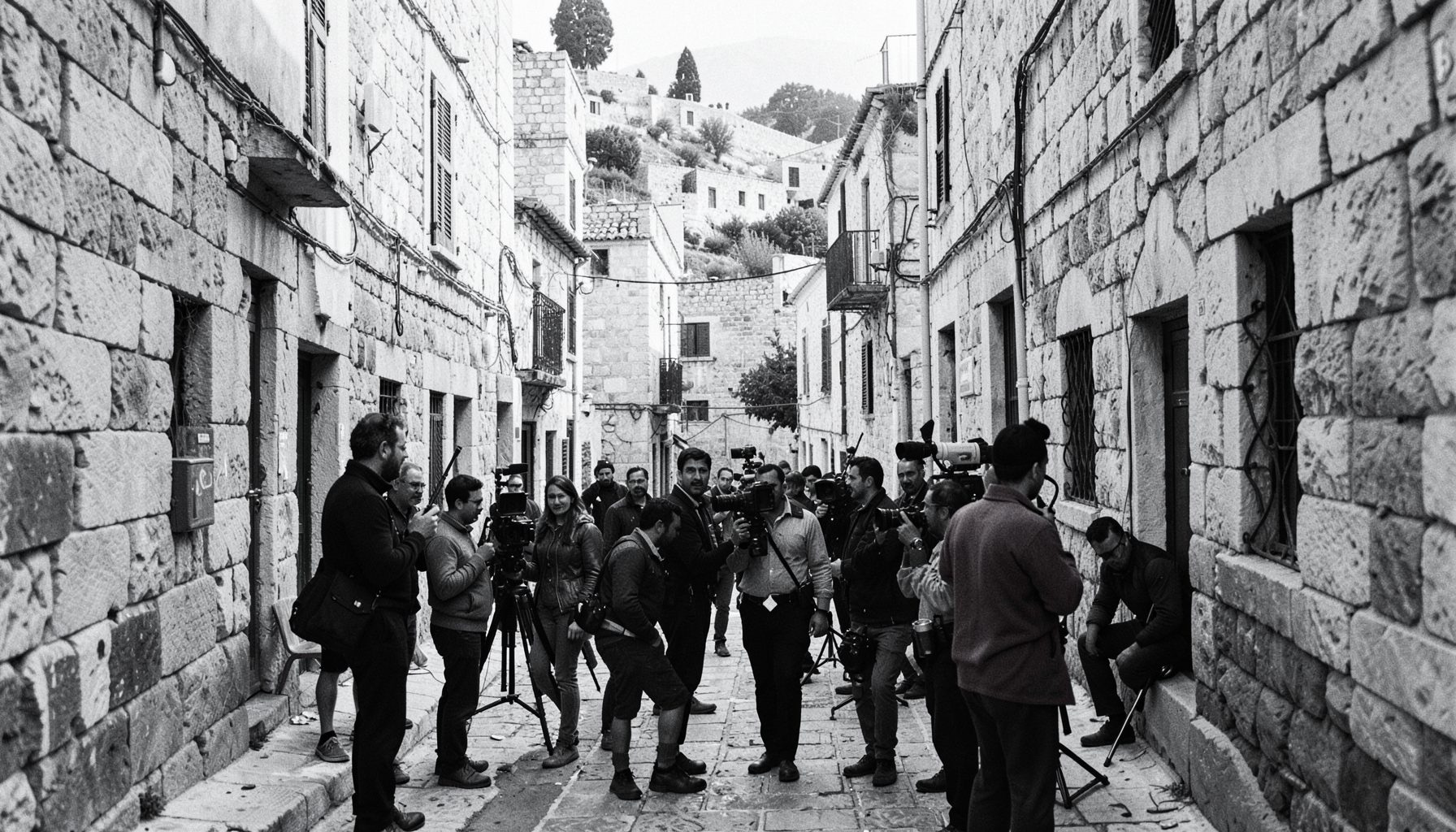
Shagrir’s method combined the immediacy of the camera with the slower work of verification. A photograph might record an official ceremony, a displaced family or a distribution queue, while accompanying notes supplied names, locations and context. The resulting collection is valuable because it preserves both the public account of events and the fragments from which that account was constructed.
His personal newspapers and clippings show how a working journalist assembled a parallel record of the Ethiopian crisis. Published reports offered competing estimates of need, descriptions of Israeli assistance and arguments over whether rescue was delayed. Read alongside photographs and film, they reveal how deadlines, editorial space and government briefings shaped what audiences were able to learn.
Close attention to those sources also exposes the limitations of the archive. Some events were photographed by other journalists, and the absence of an image does not mean an event was unimportant. Captions can compress complicated histories, while a dramatic frame may privilege one moment over everything surrounding it. The materials are most useful when studied for their relationships: what Shagrir photographed, what he wrote, what was published elsewhere and what remained outside the frame.
Aid, evacuation and the politics of rescue
Israel’s response combined relief with a highly visible evacuation effort. Food, medical personnel and logistical support were sent during the famine, while Jewish evacuees were moved from refugee camps in Sudan in a secret airlift known as Operation Moses. Launched in November 1984, the operation brought roughly 1,000 Ethiopian Jews to Israel. Further migration occurred through additional organised routes during the following years.
The operation was often presented as evidence of the Jewish people’s determination to reach Zion and of the Israeli state’s willingness to act. That account is significant, yet it can obscure the larger emergency. The evacuation reached a small fraction of the people requiring assistance, most of whom were not Jewish and were not eligible for departure to Israel. Shagrir’s coverage allows the airlift to remain a central story while retaining the wider questions surrounding famine relief, access and unequal protection.
His documentary work adds another dimension to the public record. Another route into this material is Kif Limmally, which provides access to documentary work associated with Shagrir and offers moving images to complement the written and photographic evidence. Film can capture speech, gesture and sequences of action, although its apparent immediacy also depends on filming choices. Together, the different formats show relief as a process involving queues, negotiations, negotiations with governments, medical care and difficult journeys rather than a sequence of solemn headlines.
How Australians encounter the archive
For viewers in Australia, the Ethiopian famine carries a particular resonance because drought is part of the country’s agricultural and political experience. Cities such as Sydney and Melbourne contain substantial Ethiopian, Eritrean, Sudanese and other African communities, as well as institutions with established expertise in migration and refugee history. Public libraries, universities, museums and community organisations offer different routes for encountering Shagrir’s evidence and connecting it with Australian experiences of displacement.
Daily media habits also shape how international history is encountered. Australians commonly follow international affairs through ABC radio and television, SBS news and documentaries, newspapers, podcasts and social media. This mixture can place a short-lived report about an overseas crisis within a broader information cycle. Shagrir’s preserved notebooks, photographs and films allow viewers to move beyond the momentary cycle, examining decisions that were made before aid arrived and after television crews had departed.
Australia’s cultural market provides another point of comparison through documentary festivals, independent cinemas, specialist bookshops, public broadcasters and educational publishers. Works about famine and migration can reach general audiences in these settings, while university courses and community programs support more detailed study. The material also offers opportunities for Australian editors, curators and teachers to compare government responsibility with the work of local aid organisations, including the Australian Red Cross and community fundraising networks.
Legal considerations shape the reuse of archival material in Australia. The Copyright Act 1968, including its treatment of moral rights, affects how photographs, films and articles can be reproduced. Commonwealth and state records legislation governs many Australian collections, while privacy and defamation rules may influence the publication of personal information. These laws do not determine access to Shagrir’s original holdings in Israel, but they matter when Australian researchers quote documents, build exhibitions or publish translations and edited collections.
Preserving a contested humanitarian history
Digitisation can make fragile negatives, brittle newspaper pages and obsolete film formats more accessible, but preservation also requires careful description and stable cataloguing. Dates, place names, translations and the identities of people in photographs need verification so that future researchers can distinguish contemporary evidence from later interpretation. For this material, metadata is not administrative decoration; it is part of the historical argument.
The collection supports exhibitions, educational programs and scholarly research by allowing different groups to examine the same crisis through distinct sources. Historians can compare Shagrir’s field reporting with diplomatic documents, while educators can use photographs to examine media framing and family history. Personal papers can also complicate official narratives by revealing how journalists and aid workers understood their responsibilities at the time.
Shagrir’s achievement lies in retaining the relationship between humanitarian action and political choice. His Ethiopian coverage does not reduce the famine to an isolated episode of successful rescue. It places drought, war, food distribution, medical relief, Jewish migration and international inaction within one connected history. Preserving that history gives the events a lasting form and keeps open a set of questions about who was reached, who was left behind and how the world chose to remember the 1980s.